Wednesday, November 14, 2012

Coloring With Flowers

 
Our conversations in the Gan often focus on the beautiful array of colors.  Colors of nature surround us and inspire us.  The Two’s cluster explored the garden and focused on the colors of the plants.
 
We started the guided discovery experience by giving each child a color sample to hold.  They were told that we would walk through the garden looking for a plant that matched the color on their sample card.

The children had to walk slowly and carefully while they looked for a color match.  Self control and the ability to focus were skills required for this stage of the experience.
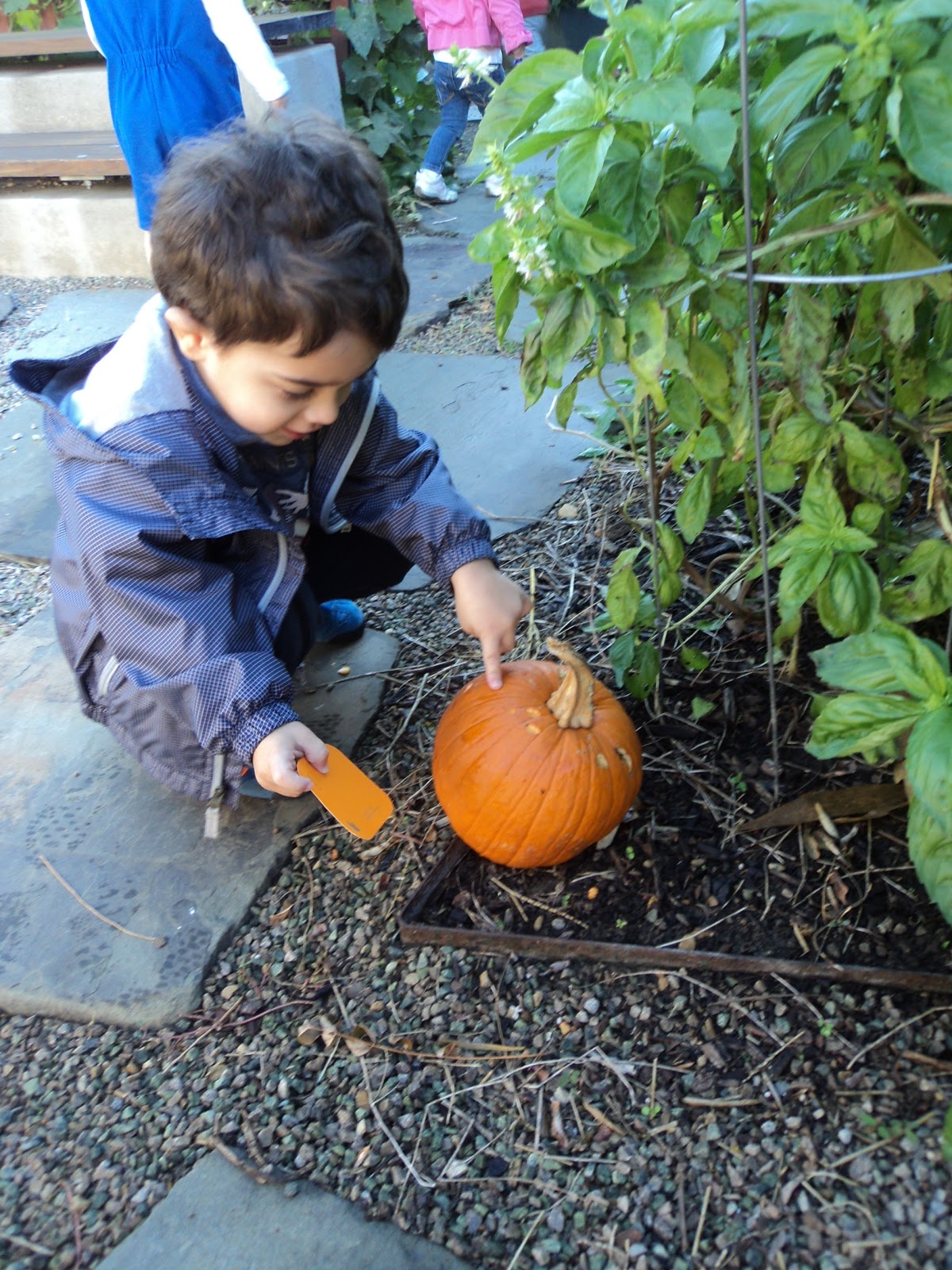
                                                              

When each child found a match, they announced to the group that they had found their color. They took great pride in their accomplishment.


To extend the discovery, we gathered back in the Blue classroom, and looked at a collection of leaves, flowers, bean pods, and wood chips that had been collected in the Gan.  I asked the children if they had ever used a crayon to color on paper.  They demonstrated with their hands how they would move the crayon to put color onto the paper. 
I asked them if they thought the color from the plants would make color on the paper.  Some said “no” and some said “yes”.


I asked how we could find out.  The answer was “press it” on the paper.  We tried.  We got a smudge.
 
I asked again how they move a crayon and then a child tried moving a flower on the paper in the same way.
 
It worked!

Thursday, November 1, 2012

The Family Reunion

Fall has arrived and the markets are filled with Halloween pumpkins and acorn squash.  Talk turns to family activities such as carving a jack-o-lantern and the family Thanksgiving dinner.  In the Gan, our conversation turned to a particular family, the Gourd family.  Our students heard the story of Pepo's Family Reunion.  We learned that Pepo (an oversized berry with a hard rind) has many cousins, and aunts and uncles.  Uncle Turk wears a turban of many colors and Aunt Chioggia must have been really old because she had bumps all over. Pepo even has a cousin named Banana squash!  One of the students  said Aunt Chioggia had "a billion bumps".

The students took a few minutes to meet Pepo's family.  They found out that some things were the same and some things were different between all the family members.  We also talked about how they have brothers and sisters, or cousins that might have the same color hair or different color eyes, but they are still part of their family. They said Pepo was "smooth like a popsicle" but another family member was "scratchy in my hand".   It was interesting to use the sense of touch to feel the different textures.

We even got to look inside and see the seeds.


Then the children went to visit one of Pepo's cousins that lives in the Gan. Cousin Loofah looks like a "cucumber" or a "pickle". It even "feels like a cucumber".  But it is "not round like Pepo".  And it doesn't have a hard rind, it is softer.

When Loofah gets old and dries out, the fiber turns into a sponge - a loofah sponge! And you can use it in the bath tub to scrub clean.  There was so much to remember about Pepo's family that the students documented their discoveries.
Do you know Pepo's family?

Wednesday, October 17, 2012

The Nature of our Holidays

As the Garden Educator, I used to approach the High Holidays with trepidation.  Just as the month of Tishrei begins, I am faced with finding time to plant the fall garden at school.  So much work and so little time.  How do I balance the planting schedule with holiday experiences.  After all, as the Garden Educator I should be focusing on gardening, right?    Well,  I realized that the holidays have a lot to do with gardening.  During Tishrei, the gan is buzzing, literally, with pollinators.  The students witness the bees collecting pollen and nectar.  They understand the source of the honey that they taste when they dip apples during Rosh Hashanah.  In Dallas, we are fortunate to have local beekeepers, The Pollards, who visit with an enclosed beehive  and educate the children about the importance   of bees in our world.                    
The children spent months watching the pomegranate tree bursting forth with bright red-orange blooms.  Then  some time in the late summer, the blooms turn into fruit.  During Simchat Torah, they learn about the midrash that says there are 613 seeds in the pomegranate to help us remember the 613 mitzvot in the Torah.  They also learn that pomegranate is "rimon" in hebrew and the finials, or crowns, on the scroll are often called "rimonim"
And then comes the harvest festival of Sukkot.  Is there a better place to honor the holiday than in a gan?  In Gan Shalom, we have post holes that have sleeves and a cap.  Each year, we remove the cap and have ready to go post holes!  The children work together to bring the corner posts to the building site.  They carefully slip the post into the post sleeve.


Soon, all four corner posts are in place and we are ready for the walls.  Eventually, the roof is in place and the children make sure that they can see the sky through the openings.  This sukkah is built by the children and is just the right size for them.
 This year, I tried something different for sukkot.  Instead of just building and decorating the sukkah, the children participated in a dramatic story.  The story  helped the children understand the original purpose and use of a sukkah.  Please watch the video and hear the story of Ezra and Rivka.

Wednesday, May 9, 2012


"Spring - an experience in immortality"
Henry David Thoreau

As Thoreau suggested, Spring is about renewal of life and spirit.  In Gan Shalom this month, we are experiencing first hand new life all around us.  Our Director prepared the coop for the arrival of our new feathered residents.


Our white Silkie is a favorite with the children.


Our children can't wait to see our new friends.

We also have five chicks that are not ready to move into the coop.


We were looking for insect eggs and discovered these on the cardoon plant.  As the children looked more carefully,  they saw the larva and pupa of a lady bug.


The children documented the life cycle of a lady bug as witnessed in Gan Shalom.


Do you know what this caterpillar really is?  Our students will tell you that it is the larva of a Fritillary butterfly.  To celebrate Spring, we made tissue paper butterflies.


Tuesday, March 20, 2012

Lunch scraps, the FBI, and Humus

Spring is on the way and that means a long list of gardening chores.  Before the children prep the beds for planting, we need a good supply of humus.  Because each class has been contributing their snack and lunch waste since September, we have a ready supply at hand.  We just need to separate the finished humus from the material which is still decomposing.

Compost is simply organic material that has decomposed.  It is essential to organic gardening because it returns nutrients to soil.  Humus is the finished product used as a soil amendment. 

We use a system of screens made from nursery plant trays and trays from a worm bin.  The first screen set has large openings and the second screen set has smaller holes.


The children scoop material from the compost bin into the first screen set.  With a little shaking, the smaller pieces fall to the tray.  The larger pieces remaining on the screen get returned to the bin to continue decomposing.
The first tray is poured onto the second screen.  A little more shaking and the humus falls down through the small holes to the tray. 
The children felt the finished humus and compared it to the original compost material.  The humus was described as "small" and "crumbly". 


When they looked at the humus, they could not tell what it had been, but the compost material still showed pieces of banana and orange peels.  They are able to see that the unused food was not wasted, but is now providing nutrients to the garden.  This practice is one method of teaching the concept of bal tashchit.

Here's a little video of a member of the FBI; fungus, bacteria, and invertebrates.  They are the allstars of decomposition.

February Surprises

 This is what February in Dallas looks like.  At least for one week during 75 degree days.   The tulips were planted in December anticipating a beautiful show in April.  Alas, it is now March 18 and only stems remain.  They were beautiful while they bloomed, even if it wasn't on my schedule.  But, that is what gardening reminds us.  We are not in control.  G-d through nature continuously brings unplanned and unexpected surprises.


After the beautiful,  sunny days, came the rains.  And I had a few surprises for the students.  We donned rain ponchos, grabbed our hand lenses and went exploring.


Some of the leaves collected water drops.  This cabbage leaf looks like a swimming pool for a lady bug.

When the rain stopped, we found a big puddle in the parking lot.  I challenged the children to "think like a scientist" and make observations about the puddle.  Several children noticed that the surface of the water acted like a mirror.  They commented that they could see the trees and the building in the water.  One child noticed that the water was moving.  I asked her what was making the water move.  She watched for a moment and then answered, "the wind".

Finally, some noticed that leaves were floating on the surface.  I asked them if they could create an experiment using the puddle.  They gathered items found on the ground and conducted a sink and float experiment.  At one point a pansy was floating.  The wind caught it and moved it forward.  One child picked it up, then placed it back on the water.  But, it was turned upside down.  The children noticed that instead of floating, it partially sank.  After a period of discussion, they decided that it sank because it had water on top of the petals.  And water made it too heavy to float.